Testi Oynatma in Turkish Cypriot Weddings: A Quiet Ritual Story
Key takeaways
- A wedding ritual shaped by community.
- Connected with wishes for abundance and protection.
- A small detail that carries a larger memory.
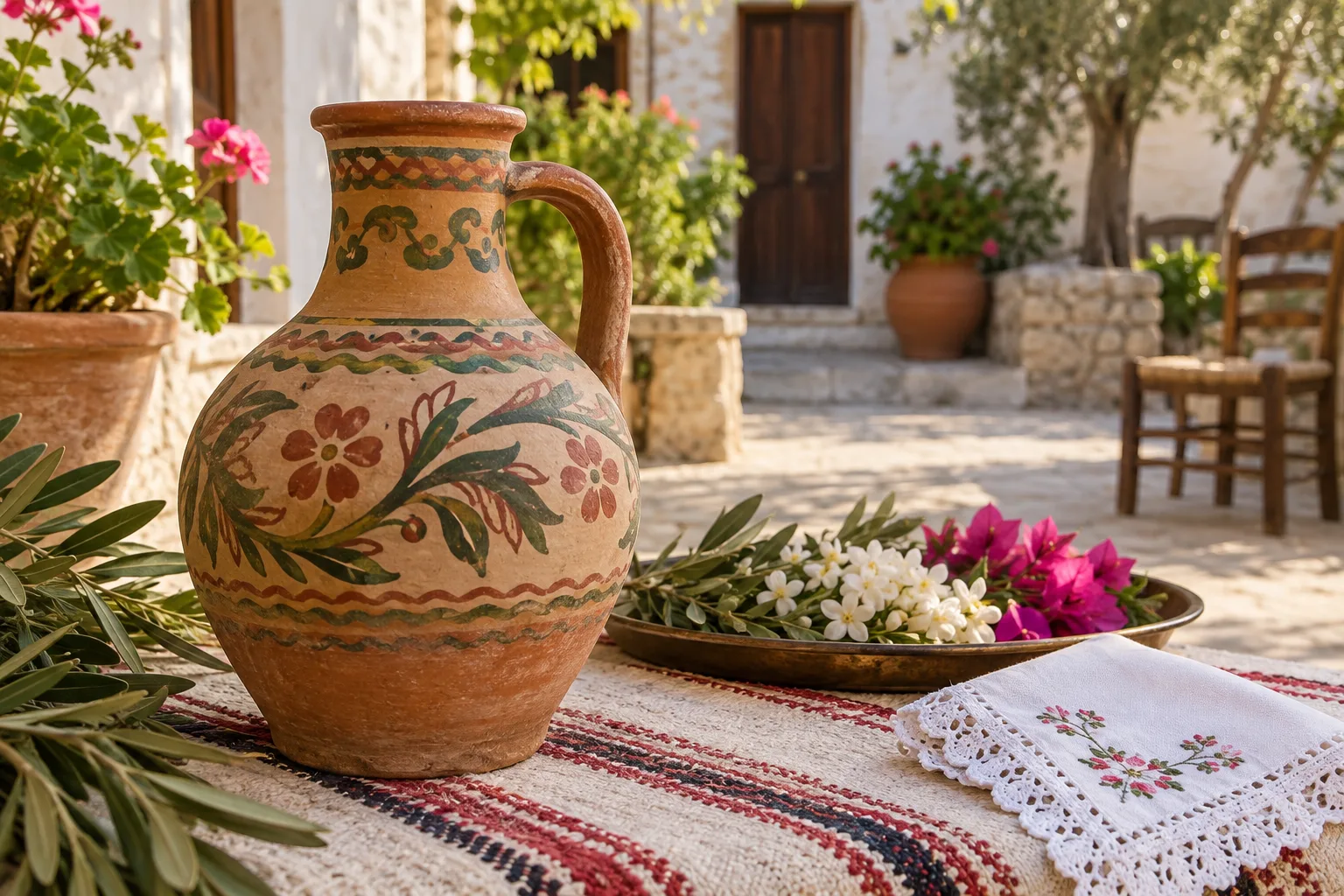
In Turkish Cypriot wedding memory, testi oynatma was more than a lively interlude. It brought a clay jug, music, movement and a gathered crowd into the same small circle. The ritual can look simple from a distance; up close, it carries wishes for abundance, protection and a new household beginning under the eyes of its community.
What happened in the testi game?
Gönül Gökdemir’s study of the ritual describes a jug filled with sugar and coins, covered with red tulle, and a “testi game” in which seven young women turn to music. In descriptions of the older form, the final young woman breaks the jug. These details should be read as part of a documented cultural practice, not as a fixed script every family must have followed in exactly the same way.
The number, the red covering, the sweets, the coins and the movement all make the moment visible. A wedding is already full of people looking, helping and remembering. The testi ritual gives that crowd a shared focus: something to follow, laugh with and speak about after the music ends.
More than one meaning
The study connects the ritual’s earlier layers with abundance and a transition from girlhood to womanhood. It also relates the local practice to older customs of breaking an object or scattering gifts found in Anatolia and Central Asia, where such acts can be associated with seeking fertility and guarding against harm. The author’s point is not that Cyprus simply copied a single outside custom. The Turkish Cypriot form developed its own more complex local arrangement.
That distinction matters. A ritual is not a museum object with one label attached. Its meaning changes with the people carrying it. In a wedding, one person may see the jug as a blessing, another as a sign of an older generation, and another simply as the moment when everyone is most awake and watching.
How the ritual changed
The same research notes that the ritual’s contemporary functions can include entertainment, young women being seen and showing their skills, and the revival of older customs. It also records how shorter weddings and migration affected the longer wedding cycles once known on the island. This is a useful reminder that tradition does not either survive untouched or disappear all at once. It adjusts to the available time, the size of the gathering and what people decide is worth repeating.
For that reason, it is misleading to describe every modern wedding as if it reproduced a past ceremony exactly. Some families keep the ritual, some change its place in the celebration, and some know it mainly through family stories. The tradition lives not because it never changes, but because people continue to recognise it.
A specifically Turkish Cypriot detail
Gökdemir’s paper makes another important observation: the testi-playing-and-breaking ritual it discusses is not found in Greek Cypriot wedding practice in the same form. That makes it meaningful to name the tradition precisely as Turkish Cypriot, while still acknowledging that cultural forms often carry wider regional traces.
The jug itself is only clay. Once it is filled, covered, carried and placed at the centre of music, it becomes a small vessel for a much larger thing: a community’s wish that a new home will have joy, sustenance and people around it.
Source
Related articles
Old Nicosia Coffeehouses: Where a City Gathered Around a Cup
A small coffeehouse could hold a city’s news, arguments and long silences.
Şeftali Kebabı: The Cyprus Grill with a Fruit Name
Şeftali kebabı has no peach fruit—only a memorable name, caul fat and the patient rhythm of a charcoal grill.

Did St Hilarion Inspire Disney? The Real Story Behind Cyprus’s Fairy-Tale Castle
Beyond the Disney rumour: the true St Hilarion story, from Byzantine watchpoint to the 1229 siege involving young King Henry I.